
Fezolinetant and Surgical Menopause: A New Non-Hormonal Treatment for Hot Flushes

A new non-hormonal drug, Fezolinetant, has received NICE approval for hot flushes. If you're in surgical menopause, here's what you actually need to know; including why HRT still comes first for most women, and who fezolinetant is genuinely for.
A note specific to surgical menopause:
Unlike natural menopause, surgical menopause happens overnight. When your ovaries are removed, oestrogen, progesterone and testosterone completely drop, often within hours. Symptoms can be severe, sudden and relentless. Current NICE guidelines and the British Menopause Society are clear: for most women under 51 who have had their ovaries removed, HRT is the recommended first-line treatment.
Fezolinetant is not a replacement for HRT, but for those who cannot take hormone replacement therapy, it may offer real relief from one of the symptoms that can be hard to manage.
What Is Fezolinetant?
Fezolinetant (brand name Veozah/ Veoza) is a neurokinin 3 (NK3) receptor antagonist, a drug that blocks a specific receptor in the brain involved in triggering hot flushes and night sweats. Taken as a once-daily 45mg tablet, it is the first non-hormonal medicine of its kind approved in the UK specifically for vasomotor symptoms.
It is not a hormone. It does not replace oestrogen, progesterone or testosterone. It targets one specific neurological pathway: the one that fires the body's heat-release response.
How It Works
1. Why hot flushes are so intense in surgical menopause: The sudden loss of oestrogen after oophorectomy causes neurons in the hypothalamus (the brain's thermostat) to become hyperactive. They release a peptide called neurokinin B (NKB), which triggers sudden, intense heat release. Because the hormonal drop in surgical menopause is abrupt rather than gradual, these responses are often more severe and more frequent than in natural menopause.
2. What fezolinetant does: Fezolinetant offers targeted, non-hormonal alternative therapy.It blocks the NK3 receptors that NKB acts on, calming the overactive pathway and reducing the frequency and intensity of hot flushes. In clinical trials (the SKYLIGHT programme), women saw meaningful improvement within one week, with maximum benefit typically reached by four weeks.
3. What it doesn't do: Because it is not hormonal, it has no effect on the wider consequences of oestrogen loss such as bone density, cardiovascular health, vaginal health, mood, cognitive function, or libido. These are all significant concerns for women in surgical menopause, particularly younger women.
Why HRT Still Comes First in Surgical Menopause
This is where fezolinetant news requires careful context for the SURGE community.
In natural menopause, HRT is one option among several. In surgical menopause – especially for women under 51 – HRT is the clinically recommended standard of care. The long-term health risks of untreated oestrogen deficiency are significantly greater when it happens early and suddenly:
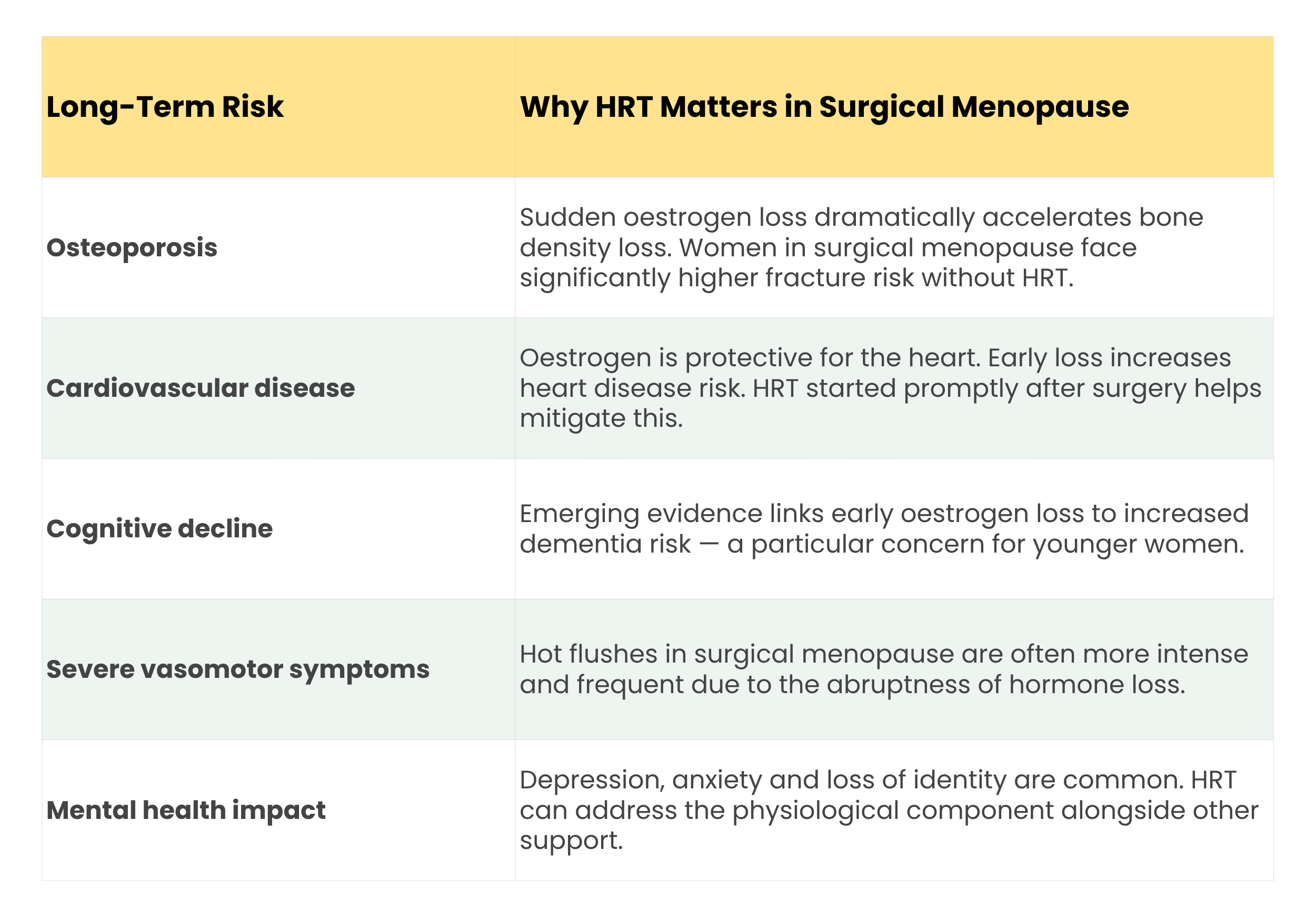
If you've been told you can't have HRT without a full explanation of why, or if you left hospital without it being discussed at all — please push for a referral to a menopause specialist. Too many women in surgical menopause leave hospital without the treatment they are entitled to.
So Who Is Fezolinetant For in the Surgical Menopause Community?
Fezolinetant is not for everyone, but for a specific group within the SURGE community, it represents something genuinely new and welcome.
Women Who Cannot Take HRT Due to Hormone-Sensitive Cancer
This is fezolinetant's most significant use case for the surgical menopause community. Many women had their ovaries removed specifically because of BRCA mutations, ovarian cancer, or hormone-receptor-positive breast cancer. For these women, HRT has traditionally been off the table, leaving them to manage severe vasomotor symptoms with very limited options.
Because fezolinetant works via a completely non-hormonal mechanism and does not raise oestrogen levels, it has been approved as an option for women who cannot take hormonal treatments. However, it is important to be clear that it targets vasomotor symptoms only, specifically hot flushes and night sweats, and does not address the wider systemic effects of menopause.
Women Whose Hot Flushes Remain Severe Despite HRT
Some women in surgical menopause find that HRT controls most symptoms well but vasomotor symptoms remain difficult to manage at certain doses or formulations. Whether fezolinetant could be considered alongside HRT in specific cases is a conversation to have with your specialist.
Women Choosing a Non-Hormonal Approach
Some women in surgical menopause may choose not to take HRT for personal reasons. If hot flushes are a significant concern, fezolinetant is worth discussing with your doctor, with the clear caveat that it will not address any of the other symptoms or long-term health risks of surgical menopause which should be fully considered.
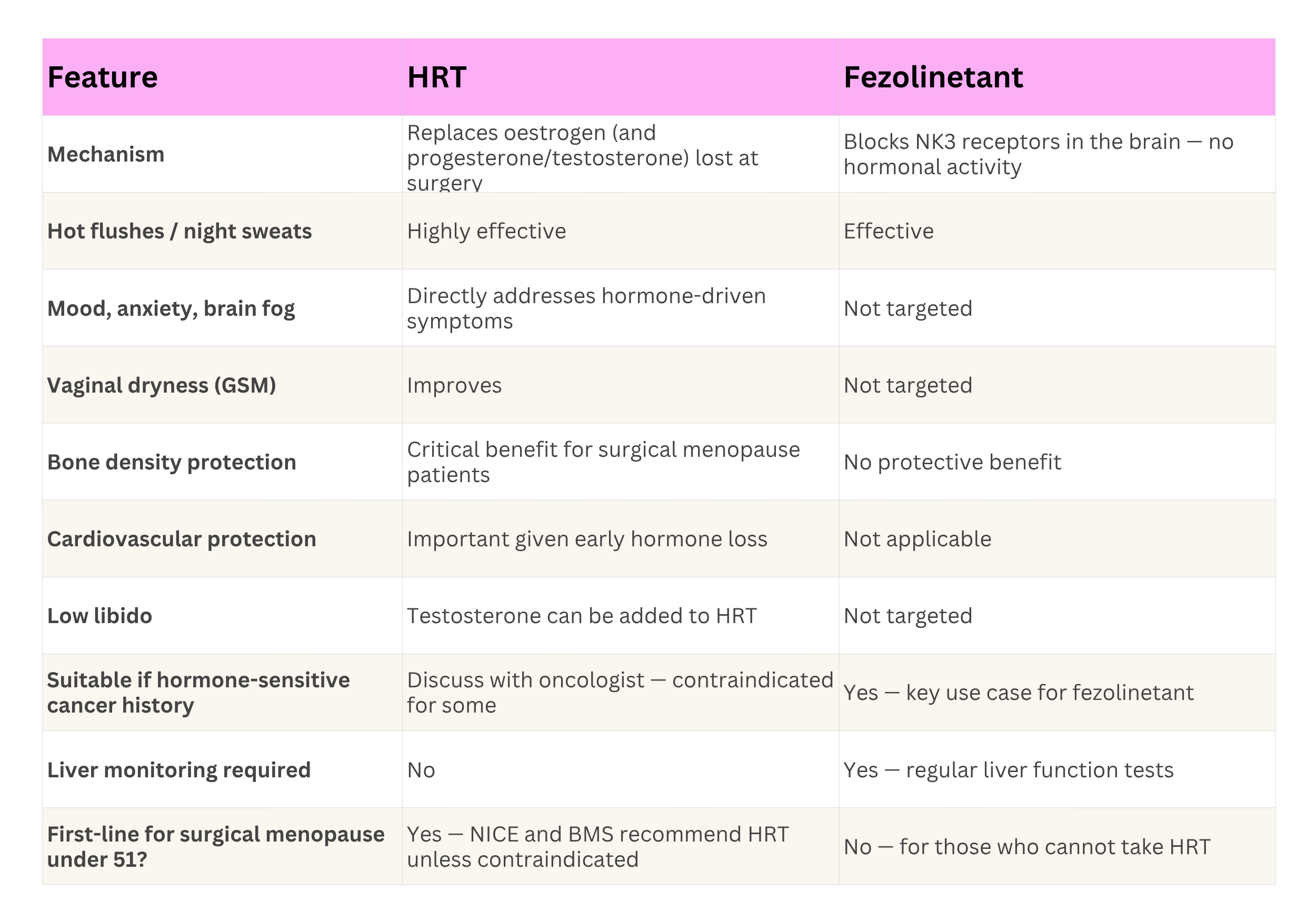
Fezolinetant vs HRT: Side by Side
For the surgical menopause context, the comparison looks quite different from how it is often framed in general menopause coverage:
Side Effects & What to Know Before Starting
Fezolinetant was generally well-tolerated in clinical trials, but there are important considerations:
Abdominal pain – one of the most commonly reported side effects; usually mild to moderate
Diarrhoea – reported in some participants, particularly in early weeks
Insomnia – noted in a small proportion, even as night sweats improved
Hot flush rebound – some women experience temporary worsening if the drug is stopped abruptly
Elevated liver enzymes – seen in a small number of women, which is why monitoring is required
Drug interactions – not suitable with strong CYP1A2 inhibitors (e.g. fluvoxamine, ciprofloxacin)
Liver monitoring is essential
Fezolinetant requires liver function tests before starting treatment, followed by monthly monitoring for the first three months. After this, testing continues at regular but less frequent intervals once treatment is stable.
In clinical trials, a small number of women developed elevated liver enzymes, and one case of autoimmune hepatitis was reported. If you have existing liver conditions, this drug is unlikely to be appropriate for you. Always discuss with your GP or menopause specialist before starting treatment.
Is It Right for You?
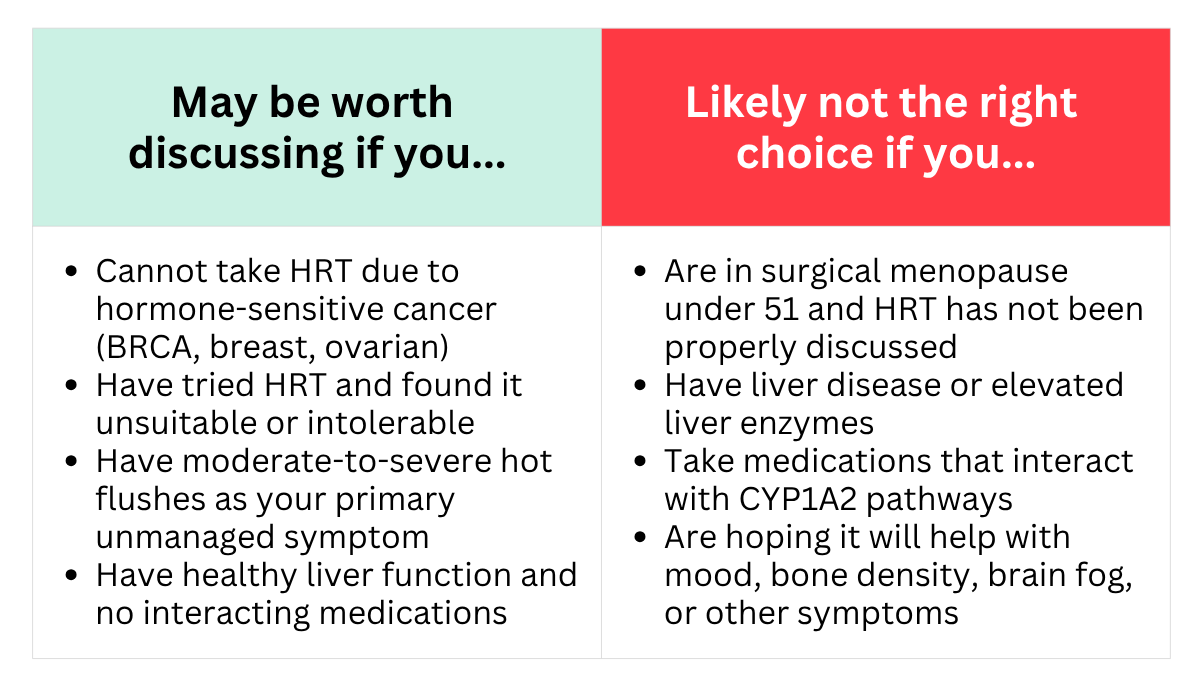
Dr Sally says…
“Fezolinetant is genuinely good news, but its significance for the surgical menopause community is specific. For women who have been thrown into menopause overnight and are unable to take HRT, having a non-hormonal option that actually targets the mechanism behind hot flushes is a meaningful step forward. No more being told there's nothing that can be done.
But we want to be clear: fezolinetant addresses one symptom. Surgical menopause is not one symptom — it is a full, sudden, and often traumatic hormonal upheaval. If you are in surgical menopause and HRT has not been properly explored with you, that conversation needs to happen first. You deserve comprehensive care, not just hot flush management.
As always at SURGE: you deserve the full picture, the right support, and the treatment that is right for you.”
